Introduction
A truly luxurious living room has very little to do with how much money was spent on it. It has everything to do with intention — the way light falls across a room, the way textures play off one another, and the way every object seems to belong exactly where it sits. If you’ve ever walked into a space and instantly felt calmer, more grounded, and a little bit inspired, you were probably standing in a room built on the principles below.
This guide pulls together eighteen approachable, designer-inspired strategies for creating a living room that feels expensive without feeling stiff or showy. Some of these ideas call for a bigger investment, like restructuring your ceiling or adding architectural millwork. Others are as simple as swapping out a lamp or rearranging your bookshelf. Together, they form a toolkit you can pull from at your own pace, whether you’re furnishing a brand-new home or slowly elevating the one you already have. For additional professional inspiration, Architectural Digest’s curated living room collection is a great place to see these same principles applied by working interior designers.
18 Luxury Living Room Ideas That Feel Effortlessly Elegant
Below is the complete roundup — eighteen distinct ways to bring warmth, texture, and quiet sophistication into your living room, organized so you can pick and choose based on your budget, your timeline, and your personal taste.
1. Build Around a Statement Fireplace
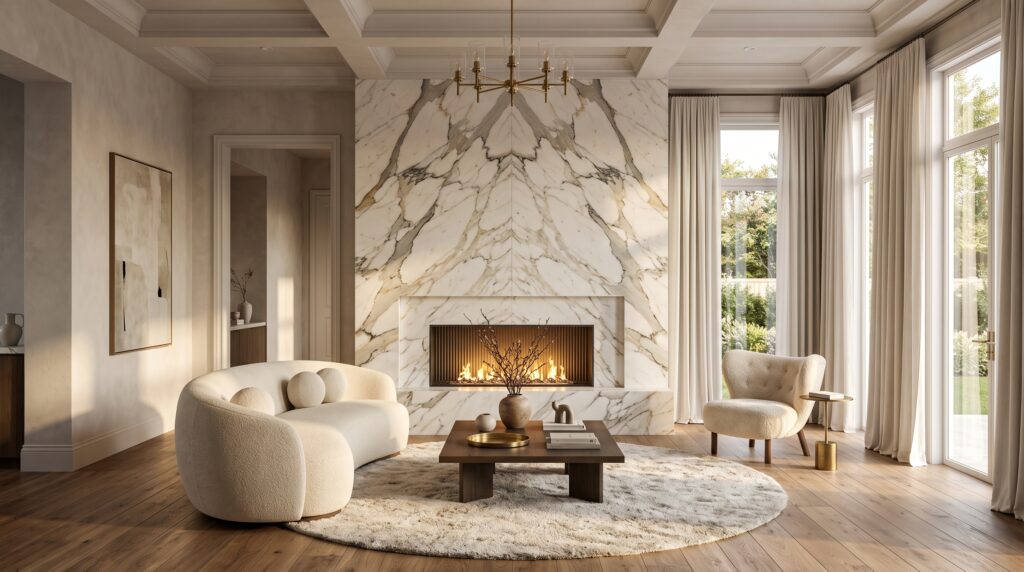
If your living room has a fireplace, let it lead the design instead of hiding it behind furniture. A wall of book-matched marble, limestone, or plaster running from floor to ceiling turns a functional feature into the emotional anchor of the room. Once the fireplace does the heavy lifting visually, keep everything nearby simple — a low bench, a few sculptural objects, and seating in soft neutral tones — so nothing competes with it.
If a full stone surround isn’t in the budget, a simpler plaster finish or a fresh coat of limewash paint can create a similar sense of texture and depth for a fraction of the cost. Even something as small as replacing a dated mantel with a clean, unadorned shelf can shift the entire feel of the wall.
2. Layer Textures Instead of Colors
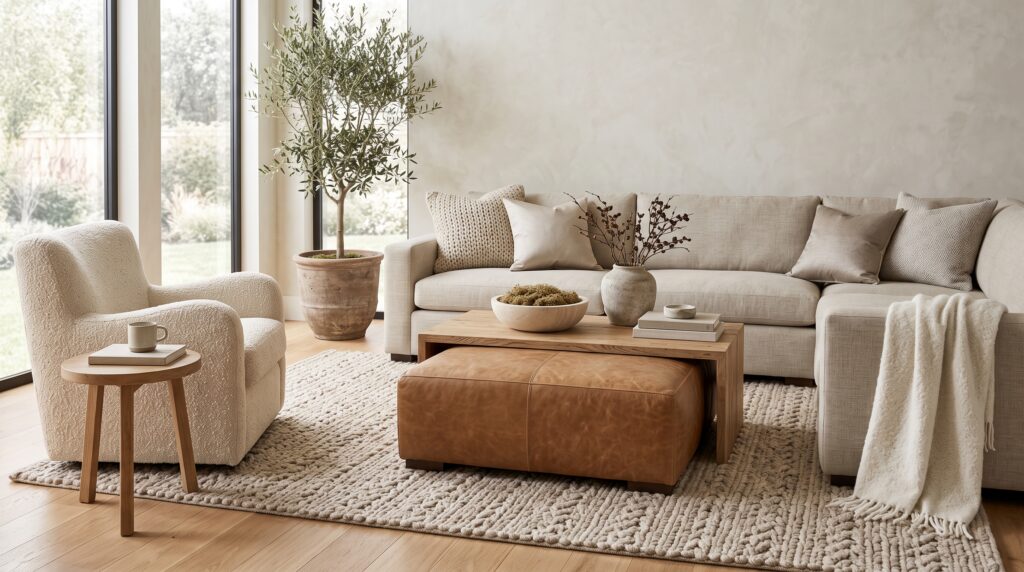
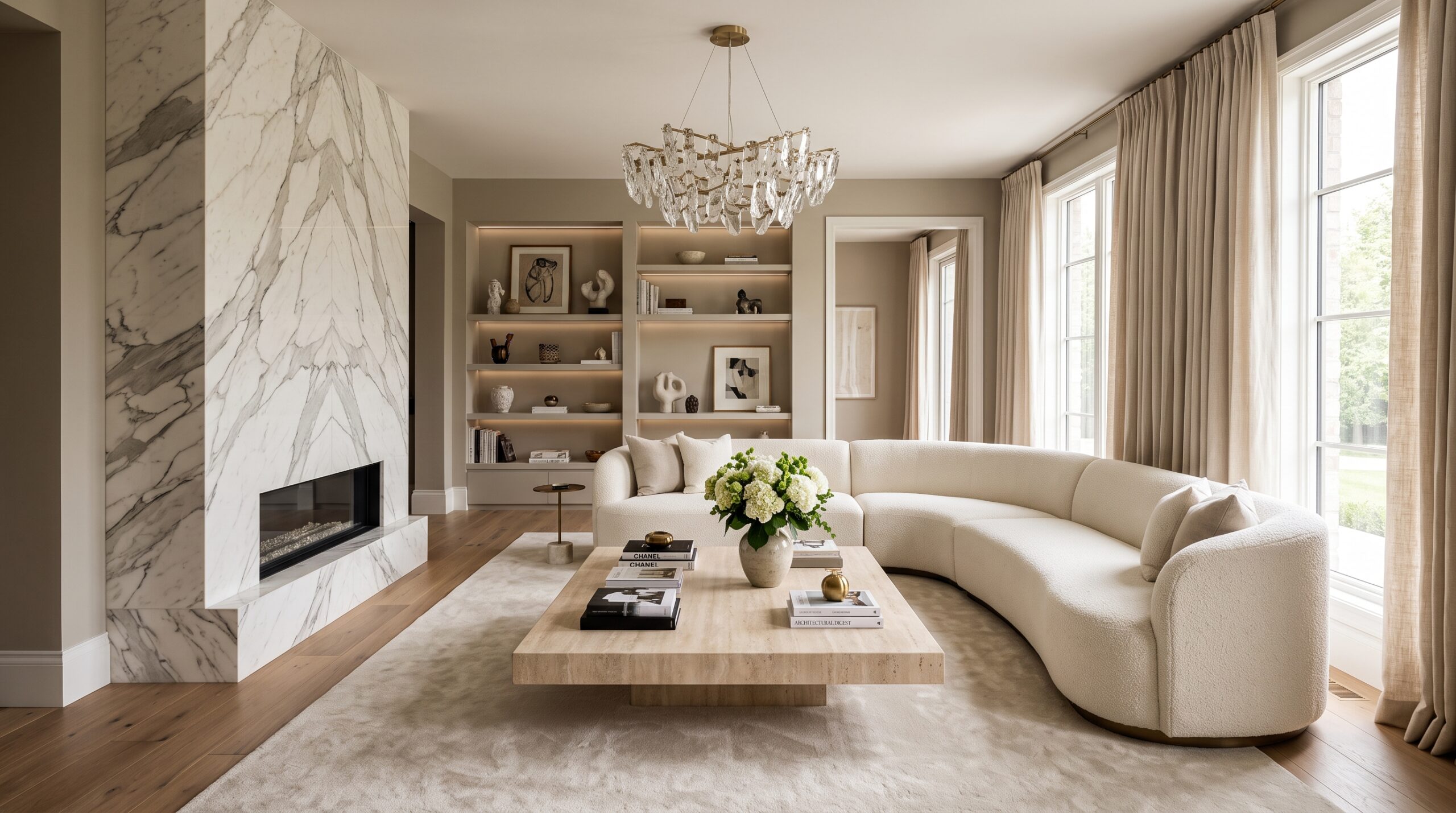
Color isn’t what makes a room feel rich; texture is. Bring together linen upholstery, a bouclé chair, a leather ottoman, a wool rug, and a raw-wood console, and you’ll notice the room feels layered and complete even in a completely neutral palette. This approach also ages well — texture-driven rooms rarely feel dated the way trend-driven color schemes do.
A helpful trick is to think in terms of contrast rather than matching: pair something soft (bouclé, wool) with something structured (leather, wood, stone) in every seating arrangement. Rooms that rely on a single texture, even a beautiful one, tend to read as flat once you spend more than a few minutes in them.
3. Let Natural Light Do the Decorating
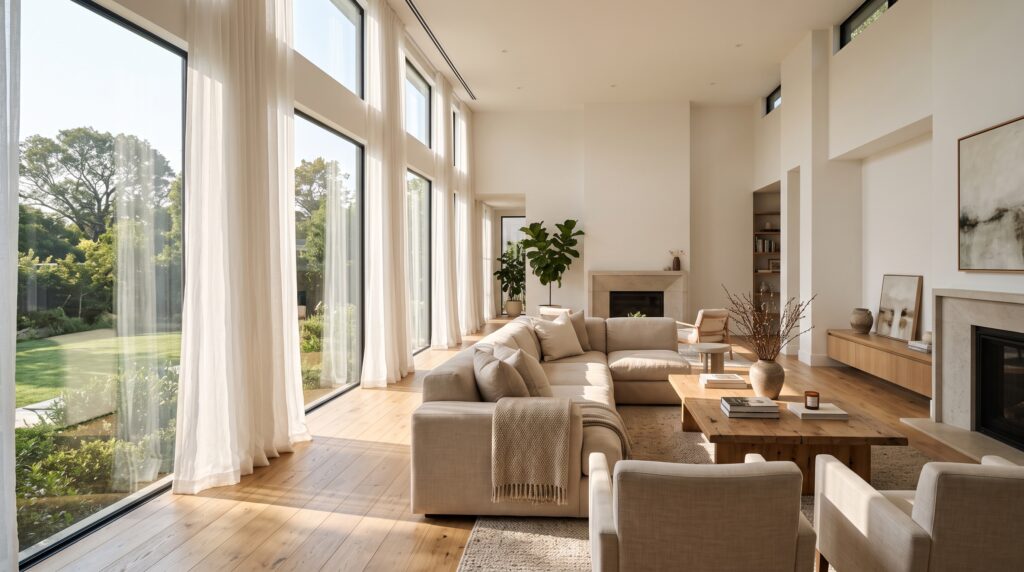
Oversized windows dressed in flowing, floor-length linen curtains do more for a room’s atmosphere than almost any single piece of furniture. The curtains should pool slightly at the floor and hang from as close to the ceiling as possible, which tricks the eye into perceiving taller walls and a brighter, more expansive room.
Mount the curtain rod several inches above the window frame and extend it a few inches past the window on either side. This one adjustment, which costs nothing beyond hardware, makes windows look larger and lets in more light when the panels are pulled back.
4. Style Your Coffee Table Like a Vignette
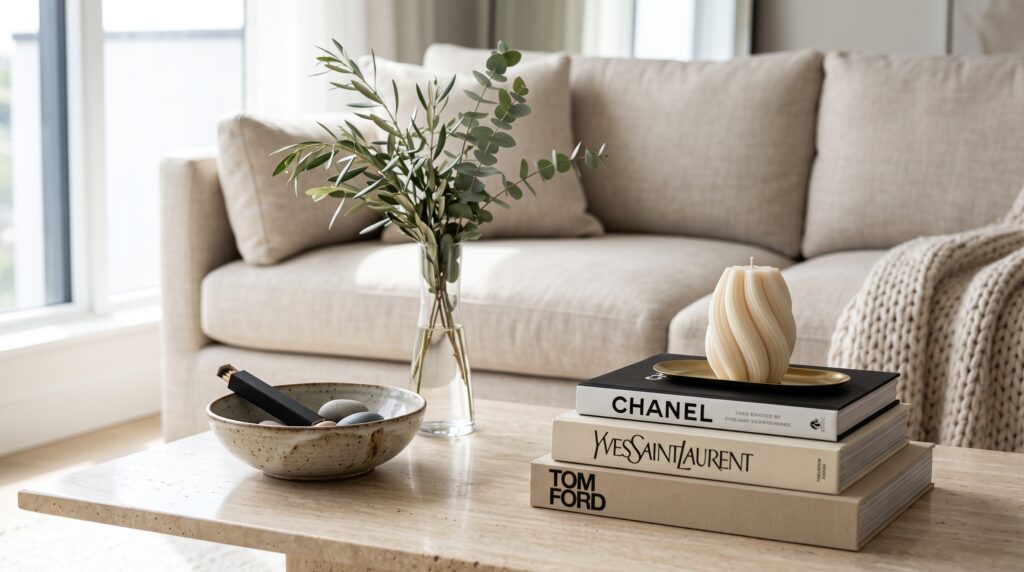
An elegant coffee table isn’t cluttered — it’s edited. Choose three or four objects with varying heights and textures: a stack of art books, a low ceramic bowl, a single sculptural candle, and something organic like a small branch or a bud vase. Leave breathing room between them. Restraint is what separates a styled surface from a messy one.
5. Choose a Curved Sofa as Your Centerpiece
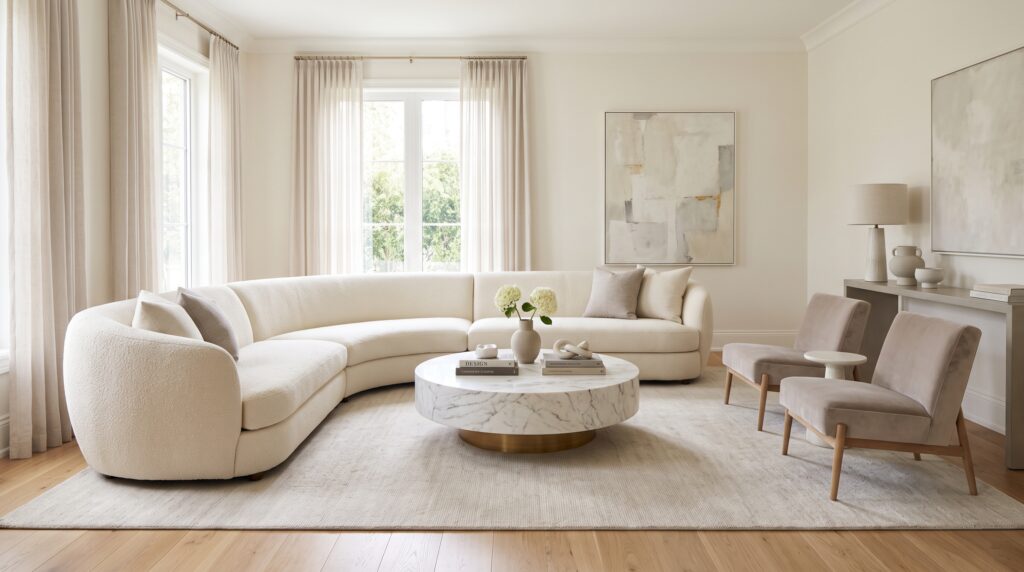
A softly curved sofa instantly reads as more considered and upscale than a standard straight-armed model. The rounded silhouette softens the geometry of the room and pairs beautifully with a circular coffee table, creating a conversation area that feels intimate rather than boxy.
Curved furniture also tends to improve traffic flow in awkwardly shaped rooms, since rounded edges are easier to walk around than sharp corners. If a full curved sofa feels like too big a commitment, start with a single curved accent chair to test the look before investing further.
6. Balance Warm Wood Against Cool Stone
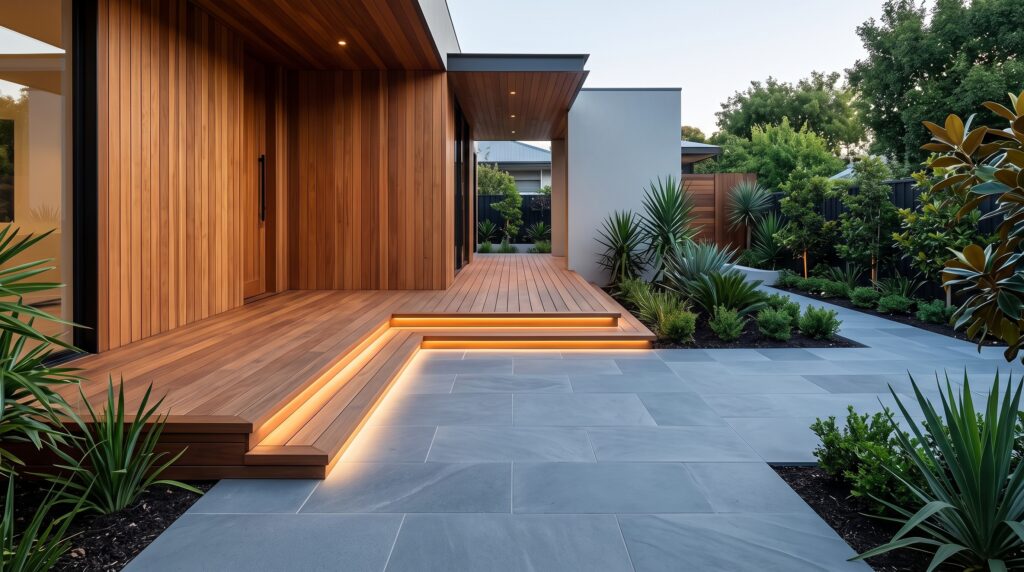
Pairing a warm wood tone — walnut, white oak, or teak — with a cool natural stone like travertine or marble creates a subtle push-and-pull that keeps a neutral room from feeling flat. This combination shows up again and again in high-end interiors because it works in almost any architectural style, from mid-century to modern farmhouse.
A simple way to start is to choose one material for your flooring or fireplace surround and the opposite material for your coffee table or side tables. That single point of contrast is often enough to give the whole room a sense of intention without requiring a full material overhaul.
7. Go Big With a Single Lighting Moment
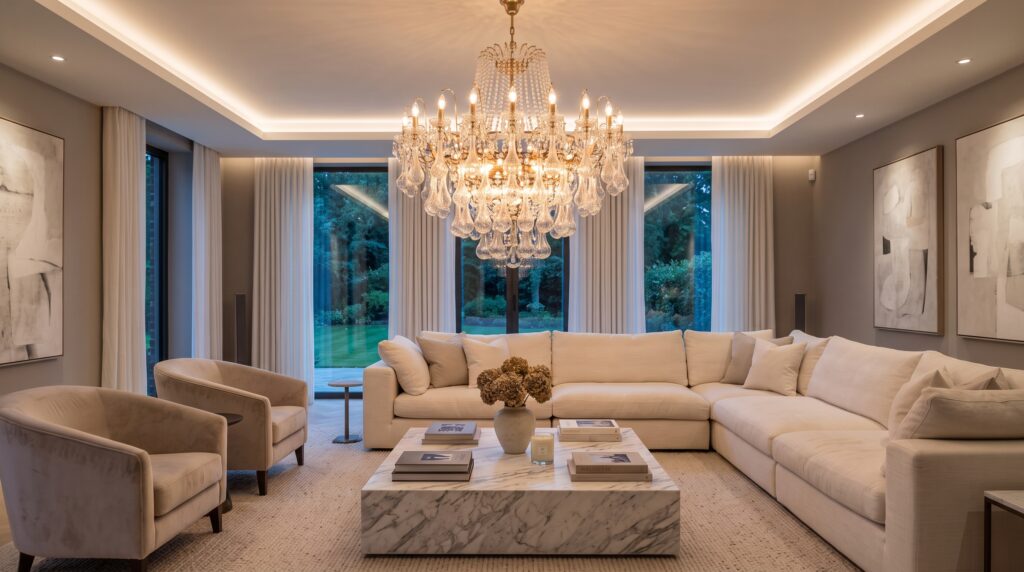
One dramatic light fixture, whether it’s a hand-blown glass chandelier or a sculptural woven pendant, can carry the personality of an entire room. Rather than scattering visual interest across many small pieces, invest in one fixture that draws the eye upward and gives the space a sense of scale and intention.
8. Add Height With Large-Scale Greenery
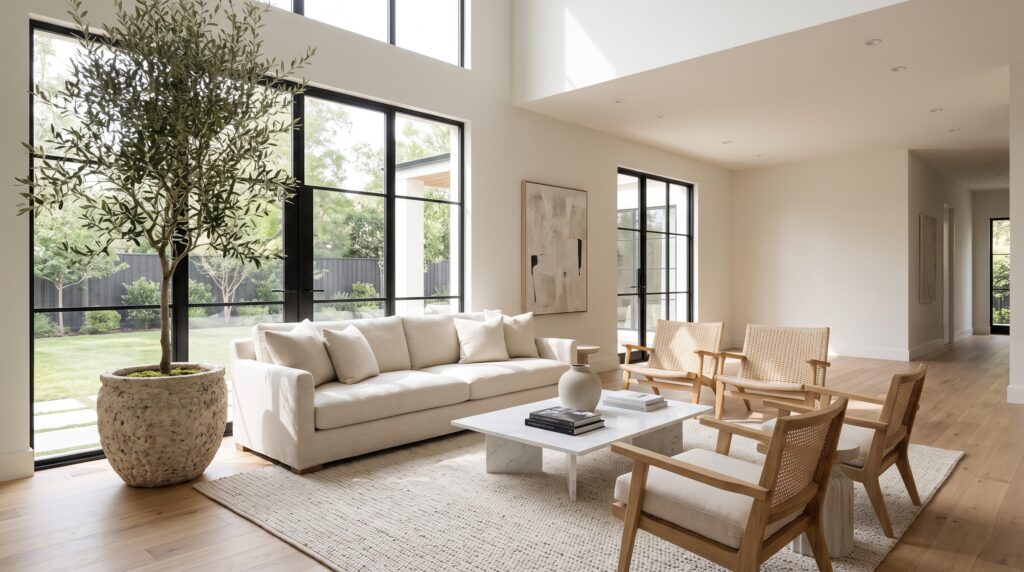
A tall potted olive tree, fiddle leaf fig, or bird of paradise instantly softens hard lines and brings a sense of life into the room. Set it in a substantial handmade or textured planter near a window with good natural light, and let it fill vertical space that would otherwise sit empty.
9. Style Built-In Shelving With Restraint
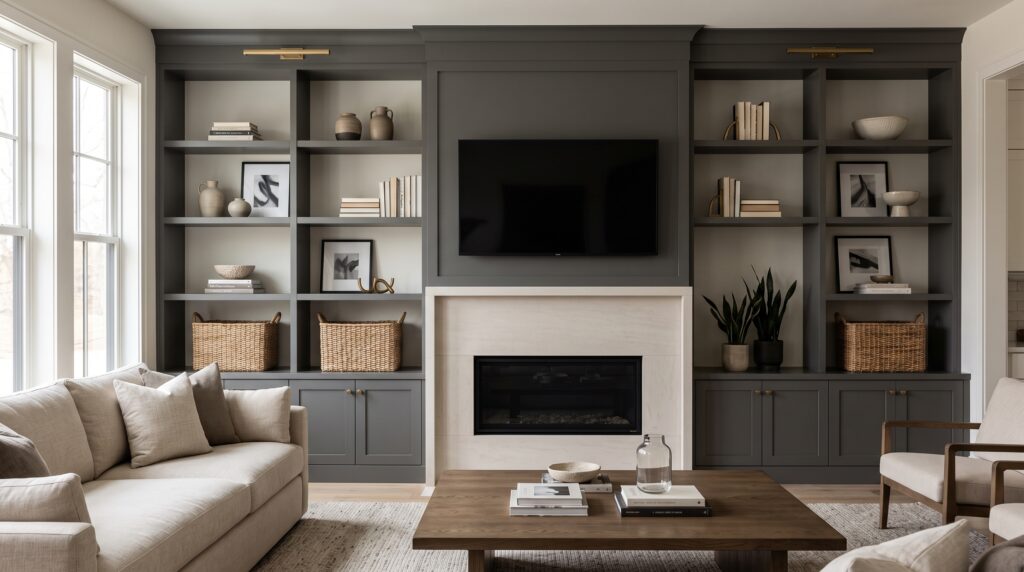
Built-ins signal permanence and craftsmanship, but they can quickly look cluttered if overstuffed. Mix books (some stacked horizontally, some upright), a few pieces of sculptural decor, one or two framed pieces, and a woven basket or box for hidden storage. Leave visible negative space on every shelf — that empty space is doing just as much work as the objects themselves.
A good rule of thumb is to fill roughly two-thirds of each shelf and leave the rest open. Grouping objects in odd numbers, and varying their height within each grouping, also helps the shelving read as curated rather than randomly filled.
10. Introduce Metal in Small, Intentional Doses
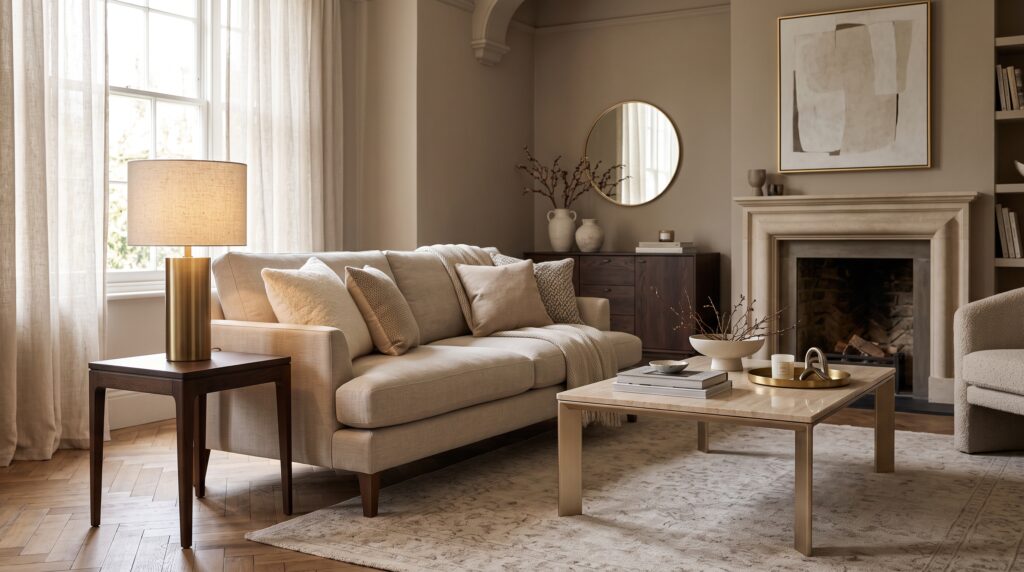
Skip anything shiny or overly polished. Instead, work in brushed brass, aged bronze, or champagne-toned metal through picture frames, lamp bases, mirror edges, or table legs. Used sparingly, metallic accents add warmth and a sense of craftsmanship without pulling focus from the rest of the room.
11. Hang One Oversized Piece of Art
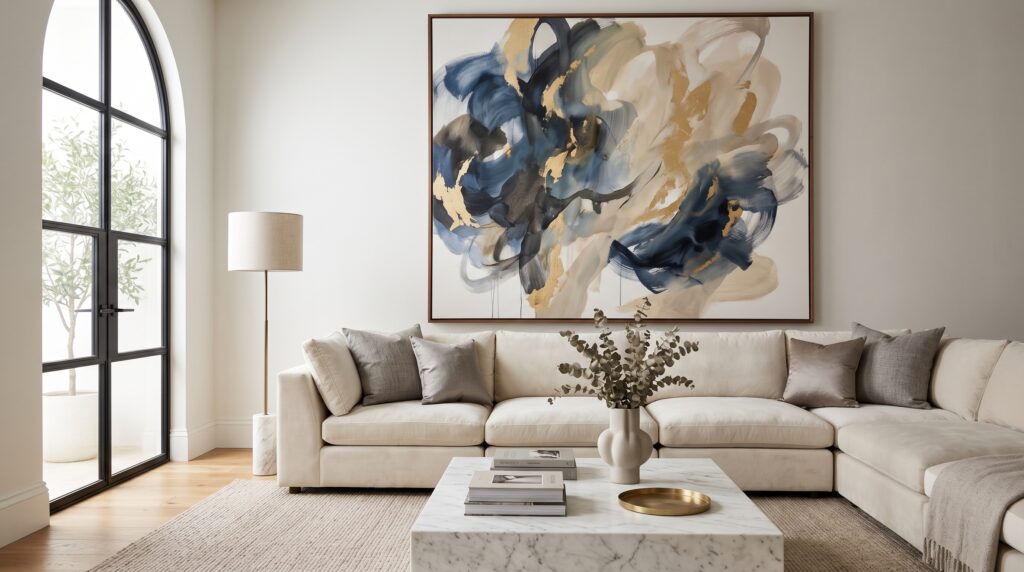
A single large-scale painting or textured canvas almost always outperforms a gallery wall of smaller frames when the goal is a polished, high-end look. Choose something with a color story that complements — rather than matches — your palette, and hang it at a scale that feels slightly larger than you’d initially expect.
As a general guideline, artwork above a sofa should span roughly two-thirds of the sofa’s width. Hanging it slightly lower than eye level, so the bottom edge sits six to eight inches above the sofa back, keeps the piece feeling connected to the furniture below it rather than floating awkwardly on the wall.
12. Layer Your Lighting for Evening Warmth
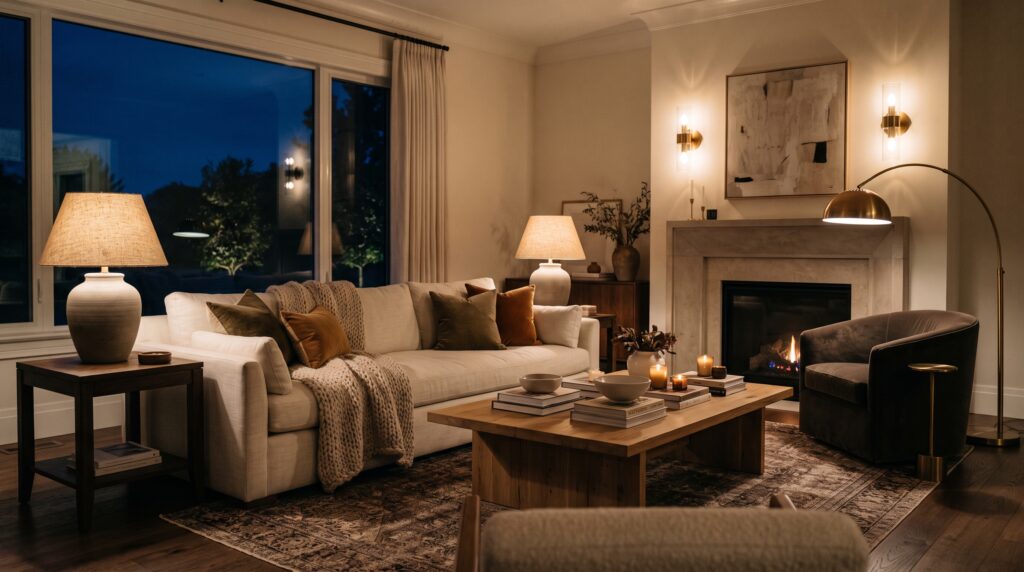
Overhead lighting alone tends to flatten a room. Combine table lamps, wall sconces, and a floor lamp so that light comes from multiple heights and directions. In the evening, this layered approach turns even a simple living room into something that feels intimate, warm, and considered.
13. Add Architectural Interest With Coffered Ceilings
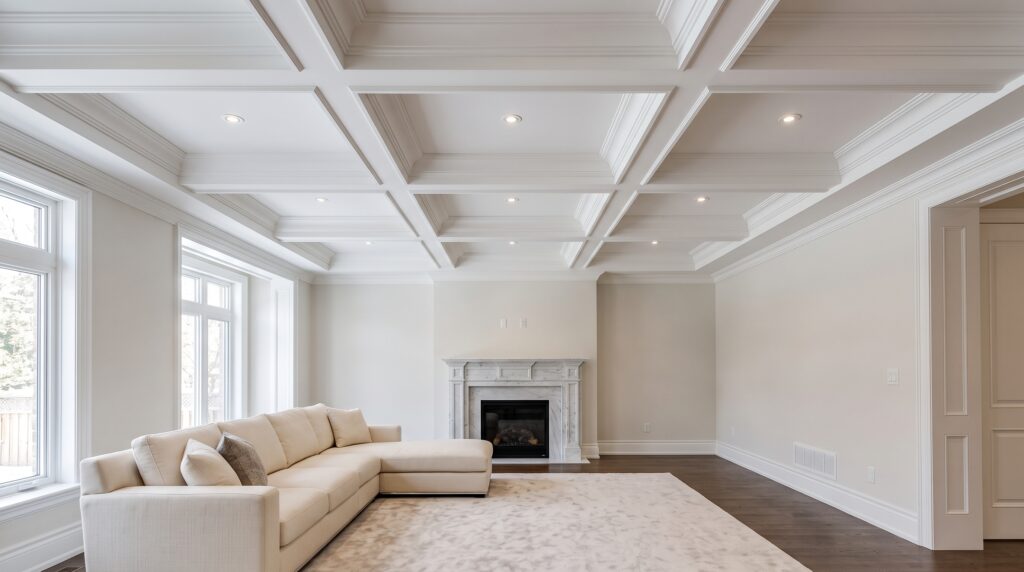
A coffered or beamed ceiling gives a room a sense of craftsmanship the moment you walk in. Paint the beams a crisp white or the same soft neutral as your walls to keep the room feeling light and cohesive, and pair the feature with recessed or hidden lighting so the architecture, not the fixtures, becomes the focal point.
14. Swap Ordinary Chairs for Sculptural Ones
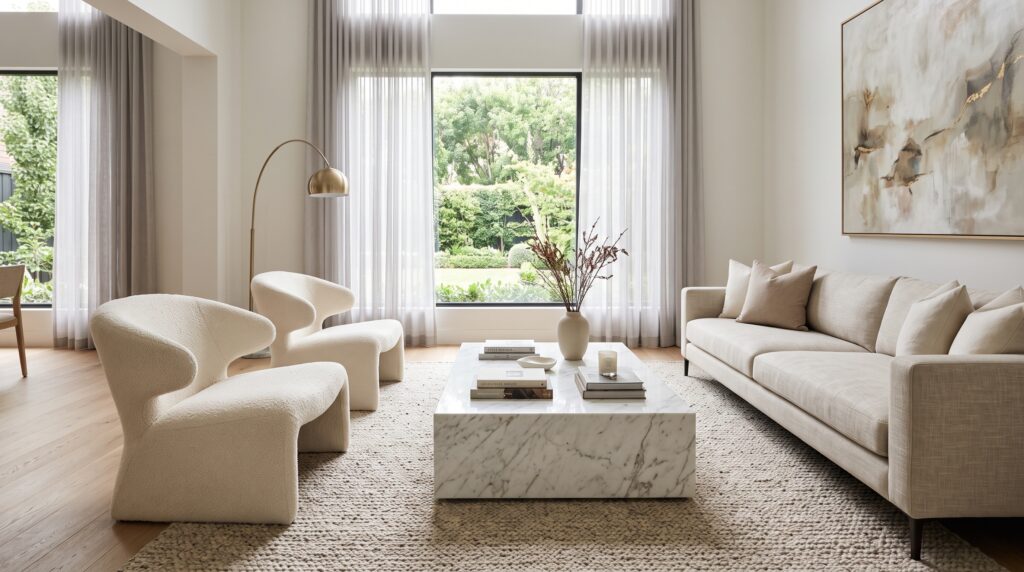
An accent chair with a rounded silhouette, a curved wood frame, or bouclé upholstery does more than seat a guest — it acts as a piece of functional art. Position one or two near your coffee table to round out your seating arrangement and add a shape that contrasts nicely with a straight-lined sofa.
15. Anchor the Room With an Oversized Rug
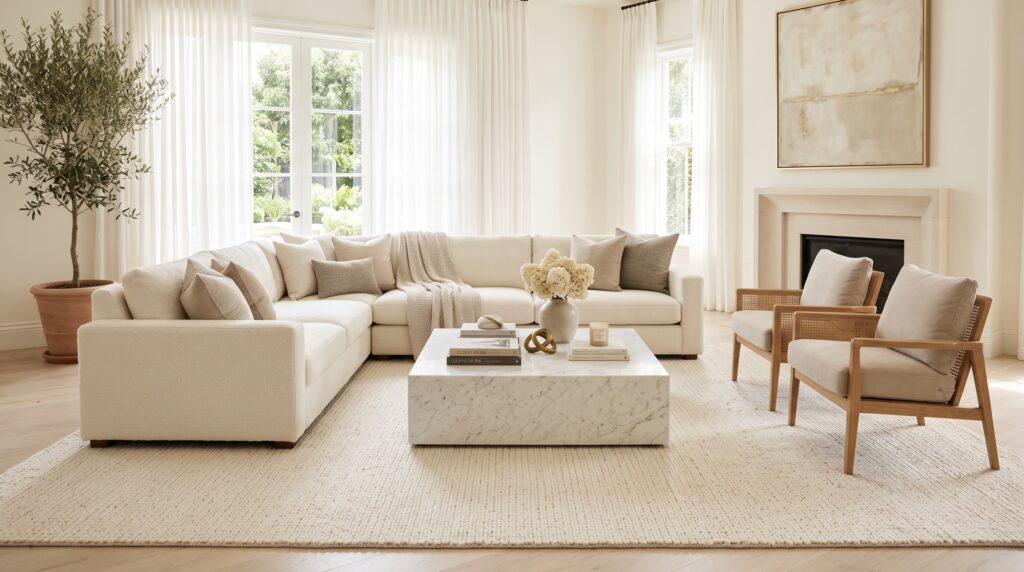
A rug that’s too small is one of the most common reasons a living room feels unfinished. Choose a generously sized wool or natural-fiber rug in a soft neutral tone, and make sure it extends underneath the front legs of your main seating pieces. This single change does more to visually “finish” a room than almost any other styling move.
When in doubt, size up. Most people choose a rug that’s too small for their space, which leaves furniture feeling like it’s floating unanchored on bare floor. Leaving twelve to eighteen inches of exposed flooring around the perimeter of the room usually gets the proportions right.
16. Bring in Fresh Flowers Regularly
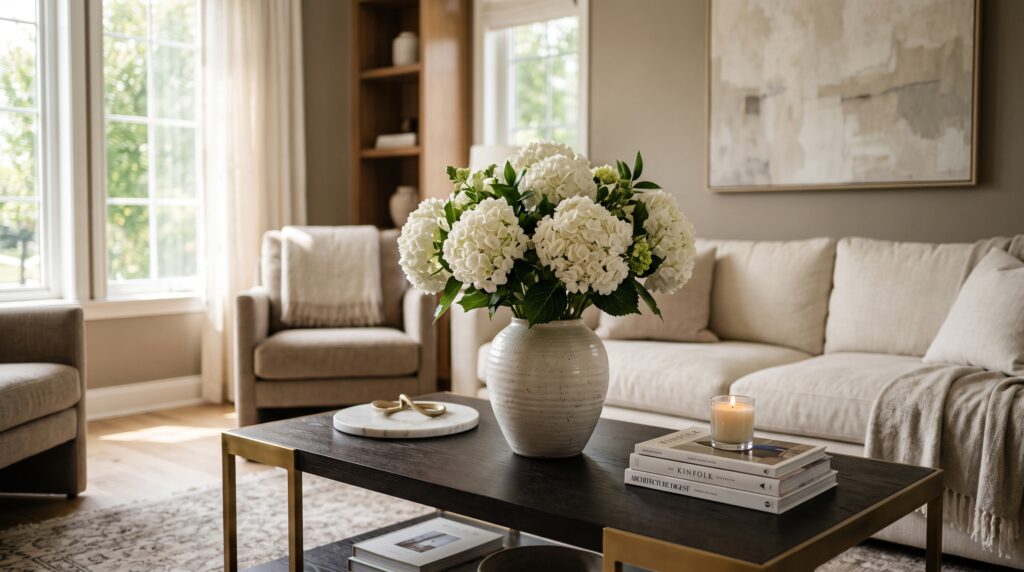
Fresh flowers are a small, renewable luxury that photographs and lives beautifully. White hydrangeas, garden roses, or a simple stem of orchids in a substantial vase on your coffee table or console instantly signals a lived-in, cared-for space — the kind of small detail that designers use to finish a room right before photography.
17. Carve Out a Quiet Reading Corner
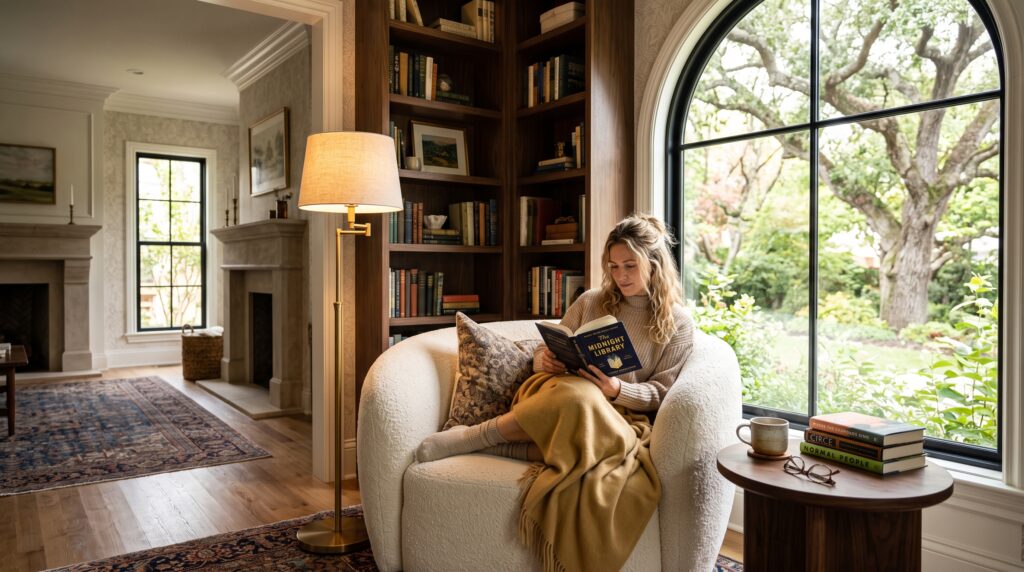
Turn an underused corner into a small retreat with a single comfortable chair, a petite side table, and a floor lamp with warm, dimmable light. Add a folded throw and a small stack of books within reach. A dedicated reading nook gives the room a sense of everyday livability that pure “showroom” styling often lacks.
18. Commit to a Warm, Timeless Palette
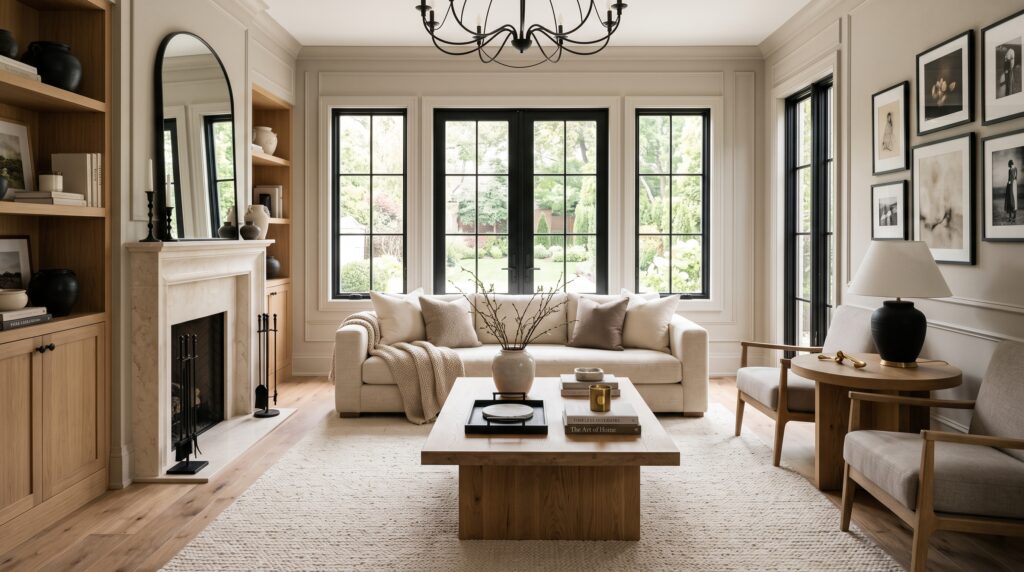
The most enduring luxury living rooms are built on a foundation of soft whites, warm taupe, greige, and natural wood, with black or dark bronze used sparingly for contrast. This kind of palette gives you room to change seasonal accessories, throw pillows, and florals without ever needing to repaint or reupholster, which is exactly why it holds up over time.
Think of this palette as the “quiet base layer” of the room, and reserve any bolder color choices for easily swappable items like pillows, throws, or a single piece of art. That way your big-ticket furniture investments stay relevant no matter how your taste evolves over the years.
Bringing It All Together
You don’t need to tackle all eighteen of these ideas at once, and you definitely don’t need a full renovation budget to see a difference. Start with the changes that require the least effort — fresh flowers, a better-styled coffee table, layered lighting — and work your way toward the bigger structural updates, like a fireplace refresh or coffered ceiling, as time and budget allow.
What ties every idea on this list together is restraint. Luxury rarely comes from adding more; it comes from choosing fewer, better things and giving them room to stand out. Whether you start with a curved sofa, an oversized rug, or simply a fresh bouquet on the coffee table, each small change moves your living room closer to that effortlessly elegant, designer-inspired feel.
If you found these ideas helpful, save this guide so you can come back to it as you work through your own living room refresh, one upgrade at a time.
Frequently Asked Questions
What’s the fastest way to make a living room look more luxurious without renovating? Start with styling changes rather than structural ones. A properly sized rug, layered lighting from a few different sources, fresh flowers, and a well-edited coffee table can transform how a room feels in a single weekend, long before you’d consider a fireplace update or new ceiling detail.
Do luxury living rooms need to be neutral? Not necessarily, but a neutral base makes a room easier to keep feeling elevated over time. Most designer-inspired spaces lean on soft whites, taupe, and natural wood as a foundation, then introduce personality through texture, art, and a small number of accent pieces that can be swapped out as trends and tastes change.
How important is lighting compared to furniture? Lighting is arguably more important. A beautifully furnished room lit only by a single overhead fixture will still feel flat and unfinished, while a modestly furnished room with layered lighting — lamps, sconces, and ambient sources at different heights — feels warm and considered the moment you walk in.
What’s one upgrade that makes the biggest visual difference? For most rooms, it’s the rug. Sizing up to a rug that extends beneath the front legs of your main seating pieces instantly anchors the furniture arrangement and makes the whole room feel pulled together, which is why designers so often treat it as a starting point rather than an afterthought.